


Orthopaedics
The Orthopaedics Department provides services with all the necessary expertise, technology, and equipment.
Supporting your freedom of movement with over a century of legacy: Orthopaedics Department
Dear Patient and their Relatives;
Founded in 1898 with a deep-rooted legacy, our hospital has been proudly served the community with healthcare services for over a century. Our Orthopaedics Department, with its expert team and well-equipped units, is here to help you preserve your freedom of movement and find solutions to your orthopaedic problems.
-
 Surgeries and Treatments We Specialize in at the Orthopaedics Department



Our Doctors
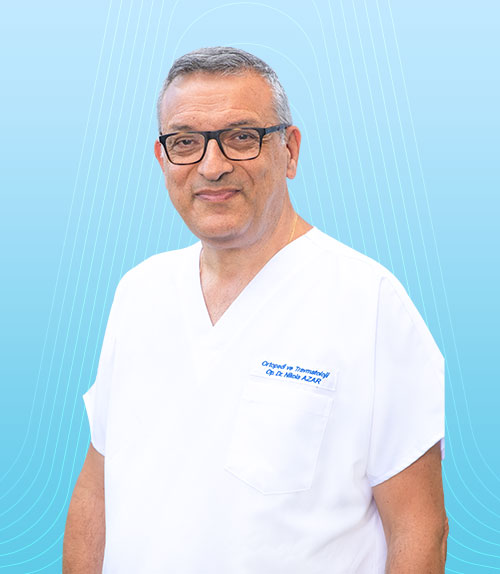
M.D. Nikola AZAR
Orthopaedics and Traumatology
Get detailed information about the Orthopaedics Department
It has been prepared by the doctors of our hospital.
Orthopaedics and Traumatology is a branch of medicine that focuses on diagnosing and treating disorders related to the human musculoskeletal system. It is divided into two main areas: Orthopaedics and Traumatology.
Orthopaedics:
Orthopaedics deals with conditions of the musculoskeletal system that are not caused by trauma (such as fractures and dislocations). Some common conditions managed by orthopaedic specialists include:
- Joint degenerations (e.g., gonarthrosis, coxarthrosis).
- Spinal deformities (e.g., scoliosis, kyphosis).
- Bone and joint infections (e.g., osteomyelitis, septic arthritis).
- Congenital deformities (e.g., clubfoot, developmental hip dysplasia).
- Tumours.
- Other pathological conditions that fall outside these categories.
Traumatology:
Traumatology focuses on the diagnosis and treatment of injuries affecting the musculoskeletal system, including fractures, dislocations, and other trauma-related conditions.
Some of the conditions managed by Orthopaedics and Traumatology include:
- Treatment of osteoarthritis affecting the hip joint, knee joint, and all other joints in the body.
- Spinal disorders: scoliosis, kyphosis, spinal fractures, spondylolisthesis, spinal stenosis, spinal infections, congenital spine anomalies, and spine-related tumours.
- Congenital and hereditary conditions, such as clubfoot (pes equinovarus), developmental hip dysplasia (DDH), femur dysplasia, and congenital tibial pseudarthrosis.
- Deformities caused by conditions that involve both the musculoskeletal and nervous systems, such as cerebral palsy and polio.
- Limb lengthening procedures to address bones that are shorter than normal for various reasons.
- Treatment of sports injuries, including arthroscopy, meniscus tears, and anterior/posterior cruciate ligament injuries.
- Management of fractures, dislocations, delayed union, and non-union of bones.
- Treatment of bone loss and osteoporosis.
- Management of tumours affecting the musculoskeletal system, both benign and malignant.
Diagnosis initially requires a thorough patient examination. Based on the symptoms and preliminary diagnosis, various diagnostic methods—such as imaging techniques (X-rays, computed tomography, magnetic resonance imaging, PET scans, etc.), ultrasound, laboratory tests, and biopsies—are used to confirm the diagnosis.
Treatment methods in Orthopedics and Traumatology
Treatment is categorized into two main approaches:
- Conservative (Non-Surgical) Treatment
- Surgical Treatment
Many conditions can be managed through either surgical or non-surgical options.
Commonly Used Treatments Include:
- Medication therapy
- Various injections: including intra-articular injections, trigger point injections, and others.
- Casting and bracing: such as fracture casts and scoliosis braces.
- Minimally invasive techniques: including vertebroplasty, true-cut biopsy, PRP (platelet-rich plasma), and injections of adipose tissue enriched with stem cells.
- Surgical interventions: including fracture fixation surgeries, joint replacement surgeries, and spinal surgeries.
Prosthetic Surgery: Hip replacement, knee replacement, shoulder replacement, and more.
Spine Surgery: Spinal fractures, scoliosis, kyphosis, spinal stenosis, spondylolisthesis, vertebroplasty, and similar conditions.
Sports Surgery: Arthroscopy, anterior cruciate ligament (ACL) reconstructions, mosaicplasty, and related procedures.
Pediatrics Orthopaedics: Congenital clubfoot, developmental dysplasia of the hip (DDH), hereditary movement system disorders, and others.
Fracture Surgeries: Treatment of all types of fractures.
Dislocation Surgeries: Acute dislocations, recurrent dislocations, shoulder dislocations, and so forth.
Tumour Surgeries: Biopsies, benign and malignant tumour resections.
Deformity Surgeries: Procedures for hallux valgus, genu varum, coxa vara, and more.
Limb Lengthening Surgeries: Correction of lower and upper limb shortening due to various causes.
Hand Surgery: Trigger finger release, carpal tunnel release, cubital tunnel release, De Quervain’s tenosynovitis, and related conditions.
Health Library